Showing posts with label transit. Show all posts

Sunday, May 6, 2012

Cool car with 2 wheels - the C-1 by Lit Motors

Lit Motors has is coming out with an enclosed motorcycle with all the amenities of a car and an electric power train. It stays stable with built-in gyroscopes and control software that Lit Motors has been working on for 8 years. It does have a "kickstand" for parking. For anyone who has read this blog before it looks very much like some of the recumbent streamliners or velomobiles shown here before. In fact it looks very much like a sketch of 2 wheel velomobile that I have been drawing except that the wheels are unfaired.

The stats are impressive:

  • Range: approximately 200 Miles
  • Battery pack: 8KWh to 10KWh still working it out
  • Top Speed: 120 mph
  • 0 to 60: roughly 6 seconds
  • Cost: roughly $24,000
  • Motors: 40 kW Hub motors in each wheel, that's right an AWD motorcycle

The vehicle shown is a concept bike so there are unfinished details such as headlights, windshield wipers, etc. But production is supposed to start in 2013 with its launch price of $24k and a target price of $16k once it is mass produced. It gets roughly three times the range of the Nissan Leaf with roughly one third the batteries. Depending on how Lit Motors engineers the charge port this means that the range per hour of charge can be very high, up to 100 miles of range per hour of charging with a standard Level 2 charger. If they use the cheaper design it would be 50 miles of range per hour of charging. Either one exceeds the Leaf's charge times of 10 miles of range per hour. I don't believe they have any desire to support Level 3 fast charging at this time.

Space wise it fits driver + 1 where the one is relatively cramped. That same spot is for cargo, and could easily fit groceries, dry cleaning, a hiking backpack, my two small dogs (Casey and Lucy), etc. It is designed for commuting and light errands which most people do alone. It is also designed for safety. It will have airbags and the gyroscopic system is designed to detect impact and maintain stability. This means that if it is T-Boned it will skid to the side and remain upright. There are 1300 ft-lbs of torque available in the flywheels. The C-1 also drives like a car, albeit a car that leans into turns. They produced this nice video which has some interesting imagery as well showing the driver's point of view as she goes through San Francisco.

For me this is a great vehicle for a new college graduate living in an apartment. I assume that charging is something that apartment owners are going to have to deal with. Putting in L2 chargers underneath car ports seems a no-brainer to me. But putting that aside, this would have been great for me when I graduated. I could go to and from work, pick up my groceries, pick up a date, go on hikes, take a trip to Portland, drive out to Vancouver, BC. Heck you could pick up a TV or computer easily enough. Anyone single could use this as their main vehicle without much trouble. It is all weather and the range is great. The standard couple in the US has two cars nowadays. Replacing one car with a c-1 seems to make sense. It can do all the light errands, commuting and even be a date night vehicle.

Personally my wife and I had been considering an EV this year, either the Ford Focus EV or the Nissan Leaf looked like a good second car. But for my usage patterns the C-1 is better. The extra range opens up some solo excursions such as hiking in North Bend and trips to the Human Powered Challenge@PIR (Portland, OR). I could visit friends in Wenatchee and bring a folding bicycle as well. It is over $10,000 cheaper than the Leaf and Focus as well as having lower operating costs. I am strongly considering putting down a reservation at Lit Motors.

Here is a slideshow of pictures I collected of the C-1. Edited to correct specs based on emails from Lit Motors.

Saturday, February 21, 2009

Vehicle Miles Traveled Tax

Transit blogs everywhere are going nuts (ref: 1, 2, 3) over the VMT proposal Secretary LaHood proposed. The White House already walked this back and said no such tax was being proposed. The problem for transit followers is that as we go to electric vehicles and reduce gas consumption it affects the national funding for highway repair and transit. Additionally the gas tax is nice but a VMT tax penalizes people for living far away from work and transit groups are anti-sprawl.

A couple of issues jump out for me. First, I am highly sympathetic with the transit crowd but the implementation of this VMT idea is being tied to GPS technology. It is a redux of the electronic voting crowd, look fun new technology is here to needlessly complicate something that works. Maybe we can make it more fragile and less reliable while opening up the possibility of hard to detect fraud. If we try hard we can open up tons of privacy concerns and increase our cost as well.

There already exists a simple mandatory technology that is in every car on the road to track miles driven. The odometer is simple, it is relied on for warranties, for assessing value and already has been made reasonably tamper-proof. Additionally the legislative and social penalties for tampering with the odometer already exist. If we want a VMT, establish various weight classes so that the 300lb EV doesn't pay the same VMT as a 4 ton SUV and base it on yearly odometer readings. Simple, easy to administer and free of troubling privacy concerns. It also requires zero retrofitting.

Secondly, I don't think this is the year for the VMT. There is a lot happening this year, we have health care reform, the second depression to scoop ourselves out of and two wars going on. Wait for 2010 for this kind of action, but remove the unnecessary technology, it is just a waste of time and energy.

Thursday, February 19, 2009

GreenWheel - easy electric kit for cycling

From Discovery News

Discovery News has this story about GreenWheel a system being developed at MIT. The cool thing about this system is that everything is contained in the wheel. Power generation, energy storage and propulsion are all in the dinner plate sized hub pictured above. The throttle is connected wirelessly via bluetooth. That means you can just swap the wheel on to a bike, trike or HPV, attach the throttle and ride away. You can still pedal the bike, which doubles the range while under power. From the article in Discovery:
Under its current configuration, a bike powered solely by a single GreenWheel (front, rear or both wheel can be equipped with a GreenWheel) has an estimated range of 25 miles. Pedaling the bike doubles the range under electric power, provided the rider isn't traveling at the nearly top speed of 30 miles an hour. The bike can be charged by pedaling or by plugging it into the electric grid.
I could see investigating this, it makes going car-light or car-free much easier, the target cost is a few hundred dollars. For that price I would happily add such a wheel to a cargo bike or utility bike such as the Rans Hammertruck . I would love to get one of these wheels for a trike to give my dad more mobility as well.
(h/t Treehugger)

Tuesday, February 10, 2009

Bicycle facilities (Soapbox)

There has been some discussion in the Cascade Bicycle Club lately regarding facilities for locking up bikes. This is a subject near and dear to my heart as I have been a cycle commuter for over 25 years*. To properly lock a bike up involves locking both tires, the frame and the seat to a solid object that is hard to remove. The lock needs to be strong and any cable based locks are considered only a barrier to casual theft. Any bike thief who has equipment can cut almost all cable locks.

These requirements get to be pretty rough. I myself only deter casual theft as carrying the necessary 20lbs of gear to really lock up my bikes is too hard. Accessories like bike computers and lights are nearly impossible to protect, the standard rule is to strip your bike of accessories and carry them with you. This gets to be quite annoying. When I was commuting in Brentwood, NY to the train station I just used a beater bike and even then locked it up at the Library 2 blocks away, near the security guard smoking station. As it was the sad bmx bike was still vandalized and I had to deal with angry notes from the Library on occasion.

Nowadays my bikes have $400 or more of accessories on them. If you add up the cost of my garmin cycle computer and my lights you hit $500 retail without even counting anything else. My Corsa's front wheel is worth $400 as well. I find myself less willing to ride a crappy bike nowadays. Why should I ride a bike that is garbage so I can not worry about it being stolen or vandalized? Especially when even dedicated care can cause problems. I commuted for 2 months in Tel Aviv by bike. I locked the bike inside the office stairwell. It was stolen 1 month in. Our investigation came to the conclusion that a courier cut the lock and stole the bike from the stairs.

Parking facilities for automobiles are typically expensive and take up a ton of space. For instance a 725 car garage built for Huntington, NY LIRR station cost $10,000,000. A cost of $13,800 per space. Spending a fraction of that cost on bicycles could easily make mixed mode commuting much more accessible. For instance there are bike lockers such as this one pictured below.

There are also bike cover type lockers available at Tri-met stations in the greater Portland area. These are plastic covers that fold over a bike, you lock it with your regular U lock or bike lock. Most bike lockers today are rented out, though some like the plastic cover style are often free for use on demand. Bike Lockers could easily be stacked if they were equipped with a tongue that comes out as a ramp. Stacking would improve the space consumption. The cover and locker style facilities really help the theft issue, especially the accessory theft. They also protect against weather. Bike facilities are much cheaper than auto facilities and take up less space. A bike locker similar to the one pictured above ranges from $500 to $2000 per bike cost. That is less that 1/10th the cost of similar facilities for cars. You can fit 4 or more bike lockers in the space for 1 car.

The point is that bikes really make commuting easier. They are an excellent solution to the "Last mile" problem that you often hear in transit issues. A cyclist will happily ride 3-5 miles on each end of a transit based commute. That cyclist also consumes less resources and parking facilities. It makes a lot of sense to improve our parking facilities to encourage cycling. I would love bike lockers or fold over covers at light rail stations, at bus transit centers and at workplaces. For every converted car commuter you would save a decent chunk of money as well as lowering maintenance costs. Congestion would also be improved or at least congestion growth would slow.

Let me hear your thoughts on this subject.

* I do count my high school bike commuting here, but since I did it every day and rode even in snow storms, I feel it counts.

Monday, January 19, 2009

A Highlight of Bike Infrastructure Improvements

The good guys at Treehugger have an article highlighting a variety of bicycle infrastructure improvements. Their point is that there is a ton of press and coverage regarding new cars and new roadway facilities but very little regarding cycling infrastructure. They mean to address that lapse and cover five examples of recent infrastructure improvements in the US and abroad..

I am a huge fan of improving cycling infrastructure. The changes in Portland, OR and NYC have like a siren call to me. I keep finding my thoughts tending to wonder what it would take to move back to Portland or NY. My wife and I were car-free for 8 years and we are now car-light with one vehicle. I have used a bike to commute to work or school since 1984 with some periods where I used mass-transit instead or coupled with a bike. Any improvement in cycling infrastructure makes me quite happy. Cycling is easy to do, very efficient in terms of energy usage, and remarkably fast way to get places. Bikes take up very little space and are simple to park. The health benefits of riding are numerous and in my experience I feel more connected with my local community when I ride, vs when I drive through it.

I hope that more cities follow the examples of Portland, NYC, and the Netherlands.

Monday, January 12, 2009

Why transit guys hate BRT


One of the traditional tools of transit opponents is the promise of Bus Rapid Transit. It is pitched a lot because there are no right of ways to negotiate, road infrastructure is loved by transit opponents and is considered "free" and it can be used to kill rail. Then of course no one funds the buses and infrastructure for the BRT system and many people hate to use buses. Mostly because they are fine for local trips but bad at being part of a longer distance backbone. Buses are also easy to kill by inches, keep the system, spread the frequency out and no one will use it because they can't get to their destination on the schedule they live and work with. Then kill the entire system due to lack of use. It is a standard ploy.

Openroads has a nice link to this being used in 1946 in Detroit, so classic. The funny thing is that so many people find BRT ideas new and innovative.

Congestion Pricing - IBM ad


This is IBM's commercial regarding congestion pricing and how it helps traffic flow and improves energy efficiency. I have read quite a bit about congestion pricing in various blogs and am glad to see IBM bringing the concept mainstream.

(h/t The Overhead Wire)

Monday, December 1, 2008

Forced love affair

No Impact Man has a nice article up on how cars were forced on us. Follow the link for more data but I do want to pass on this quote block.

What is interesting to me here is that GM was forced to pay fines due to anti-trust issues related to this. Some people like to call this talk of rail killing the city-lights conspiracy as if labeling it a conspiracy makes it not real. The 1949 anti-trust fine pretty much blows that idea out of the water.
In a 1922 memo that will live in infamy, GM President Alfred P. Sloan established a unit aimed at dumping electrified mass transit in favor of gas-burning cars, trucks and buses.

Just one American family in 10 then owned an automobile. Instead, we loved our 44,000 miles of passenger rail routes managed by 1,200 companies employing 300,000 Americans who ran 15 billion annual trips generating an income of $1 billion. According to Snell, "virtually every city and town in America of more than 2,500 people had its own electric rail system."

But GM lost $65 million in 1921. So Sloan enlisted Standard Oil (now Exxon), Philips Petroleum, glass and rubber companies and an army of financiers and politicians to kill mass transit.

The campaigns varied, as did the economic and technical health of many of the systems themselves. Some now argue that buses would have transcended many of the rail lines anyway. More likely, they would have hybridized and complemented each other.

But with a varied arsenal of political and financial subterfuges, GM helped gut the core of America's train and trolley systems. It was the murder of our rail systems that made our "love affair" with the car a tragedy of necessity.

In 1949 a complex federal prosecution for related crimes resulted in an anti-trust fine against GM of a whopping $5000. For years thereafter GM continued to bury electric rail systems by "bustituting" gas-fired vehicles.

Saturday, October 18, 2008

Transit and Energy independance

I am a big believer in mass transit, particularly trains, light rail and street cars. Small town America was created due to our growing rail system. To quote Lance Mannion
The first suburbs sprang up at the end of the 19th Century and were built not off of highways but along rail lines. They were small towns that in growing grew into one another but did not lose their individual identities or economies and many of those not only still exist but still thrive as distinct towns with prospering main streets.
So when we think about the need for energy independence we need to think about transit. Reducing cars and eliminating huge parking lots will go a long way to making the places we live much more beautiful and livable. I was reading this excellent article how if the next administration develops transit, the work can be used to create jobs and improve the economy. It is well worth the read. Investing in our infrastructure is exactly the kind of long term thinking we need in Government. US enterprise is all short term thinking, where are my profits next quarter style thinking. We need to take a longer view.

Thursday, October 2, 2008

Tired today


The ride in was interesting. I saw a electric car trike coming the other way on 124th, in red. I believe it is one of these, now made by Myer's Motors . After putting out a few fires my team headed off to K1 Speed in Redmond to race go-carts around.


I got bumped a few times in our three races. Jim got the fasted laptime overall. The go-carts are electric as well. It was quite the day for plug-in electric vehicles. Hopefully I will have enough energy to ride home safely.

Wednesday, September 24, 2008

Commuting home in the rain

My ride home tonight was a bit wet. A good test of my gear and ride in wet conditions. Everything passed. I don't have my accessory mount yet so I was without a headlight but the ride wasn't bad without it.

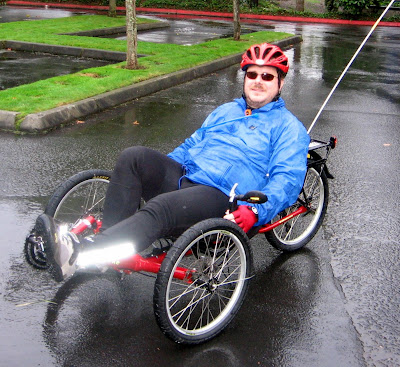
I looked like this today:
From September Commuting


As you can see I was wearing my cycling clothes. Performance pants, my fall ones, they handle the rain very well and work as long as it is above freezing. I should get a second set, they were perfect today. I had a rain slick on which is a gift from my Dad as he doesn't ride anymore. I used my Ortlieb Panniers, which are just amazing and I wouldn't replace them. Rain proof, nearly indestructible and so easy to take on and off. I used shorty gloves which I was glad to have in the rain.

So now you see what I look like today, 40lbs heavier than the picture in my profile. The last year has been a rough one for weight gain. But I am pushing hard to lose it now. With my newfound desire to ride every day it should drop. I will be doing some upper body workouts as well.

Regarding commuting I was very pleased at the ride today. The hill wasn't so bad, the route was reasonably fast for a first day back in 1 year, and the rain was not a problem.

Cycle Commuting - First day back on the trike

So today was my first day back on the trike for commuting in over a year. As part of my new QOL improvement strategy I am cycling commuting again. I did a bit of prep before I started again.

  1. Cleaned out the garage so I have a cycle maintenance area.
  2. Cleaned and lubbed the chain.
  3. Cleaned the trike and adjusted the seat forward a bit.
  4. Installed a new cateye rear blinker (works great attached to the rack)
  5. Bought new shoes, my current shoes are 7 years old and a bit worn.
  6. Ordered a new accessory mount for the lighting system. (terracycle mount, jet-lite system)
I pre-packed my clothes and panniers for the ride this morning after a test ride last night. I decided to go with the full change of clothes method vs riding in work clothes. Apparently my winter cycling pants still fit, which shocked me but I did gain most of my weight in my stomach. I rode a new route. I took 7th Ave up the hill, turned left at the tracks and cut over to 100th ave. I then rode to 124th heading south to 90th, then turned down 90th to get to my office. As routes goes this worked very well, the ped bridge at 100th is nice and wide. The inclines weren't horrible. I prefer this to my 80th st/kirkland ave route. That hill is brutal, as is the ascent to the ped bridge at 80th.

Today's ride was awesome. Felt great and everyone waved and smiled as I passed.

Tuesday, September 23, 2008

Interlude - cycling

I have been focused on getting back into shape this week. I decided that cycling and cycle commuting is the way forward. I commuted for 7 years straight on a bike, so this is familiar territory.

My chosen commute vehicle will be my trike seen here in a picture taken last year:
From Blogger Pictures


I am going to add a new accessory mount to it to replace the one you see in the photo above. This is the one I am going to use:
(follow link in picture to see it at terraclycle.com)

I added some lighting and other gear to the trike. Additionally I cleaned out the garage so I can turn it into a work area for my trike and my Wife's Rans Cruz. I am going to put a Metolius Slim Gym in the garage too.


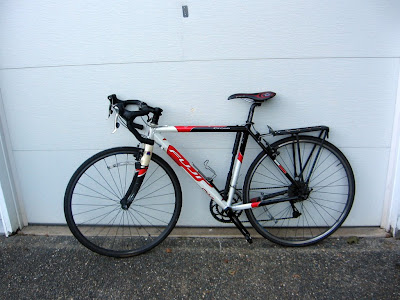
This means I have to sell the other bikes in my stable. First to go is my Fuji Cross 2003. Lots of added gear -
2003 Fuji Cross,
52 cm Frame,
Carbon fiber front fork,
Compact Double crank,
11-34 rear cassette,
Shimano 105 components,
Rear derailer Shimano XT,
Speedplay Frog pedals (cleats available),
Richey rims,
Rear Rack installed,
Detachable Fender kit included (easy on/off works great),
From Fuji Cross 2003

The album has more pictures if you follow the link.

Friday, September 12, 2008

Atrios on Urban NIMBYism

Atrios can be seen here commenting on urban NIMBYism and its single-minded focus on parking. Which he argues is odd as more parking has the effect of bringing in more cars and consequently reducing the appeal of the neighborhood. For myself, I agree with Atrios and not just because we share a first name. I think people focus on parking way too much. Parking is part of our car culture and this is a large part of what we need to change. For instance, I like Portland and its lack of downtown parking but providing ample bike lanes (including a double-wide one), light rail, trolley and dedicated pedestrian/cyclist pathways.

I deeply hope we can start moving to a more transit focused development style in this country. We need to do this to free ourselves from the shackles of oil.